


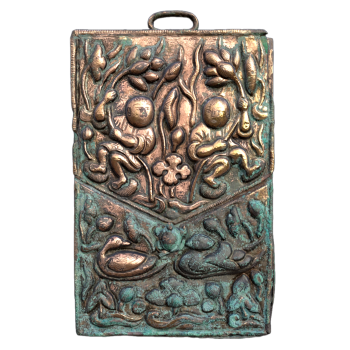
The container of Tibetan sutra in the period of Koryo
This relic is a box of sutras known as the "container of Tibetan sutras", from the Korean Koryo period (918-1392) around 1100 AD. It is made of gold-plated copper with embossed decorations, and the overall dimensions are 10.2 x 6.5 x 1.5cm. This sutra box was once used to preserve miniature Buddhist sacred texts. By hammering the reverse side, the front and back of the box are engraved with relief designs depicting a peaceful pond boy holding a huge lotus in his hand and a pair of mandarin ducks swimming. These playing boys may represent the newly born soul in the Pure Land. Collected at the Cleveland Museum of Art.

Iron Buddha Statue of Shakyamuni during the Goryeo Dynasty in Korea
This artifact is a cast iron Buddha statue from the Goryeo Dynasty in Korea. It is now housed in the British Museum in London. Its production date is from 918 AD to 1392 AD 1234. This Buddha statue is made of cast iron. The Buddha statue was discovered at a temple site in Hasachangli, Gwangju, buried to the waist. Many features are similar to the main Buddha statue in Shiku Temple, such as the outer robe covering only one shoulder, fan-shaped folds in front of the crossed legs, and a right hand lowered towards the ground. This statue was made in the early Goryeo period of the 10th century.

Korean Koryo period bronze clock "Buddhist temple bronze inscription ceremony clock"
This bronze ceremonial bell is a Korean artifact from the Koryo period (918-1392). Its name is "Buddhist temple bronze inscription ritual bell". The decoration of this bell is very fine, made of cast bronze with engraved inscriptions, the bell was made in the 1200 AD generation. Once used as part of a Buddhist indoor ritual, the bell hangs in a Buddhist temple with a cast dragon on top and a vertical tube to amplify the sound. The inscription indicates that it was cast in the Year of the Dragon, took three years to make, and is now in the collection of the Cleveland Museum of Art.

Joseon Dynasty Scroll Box "Painted Wood Dragon and Phoenix Scroll Box"
This set of scroll boxes is a Korean cultural relic from the Joseon Dynasty (1392-1910), and its name is "Painted Wood Dragon and Phoenix Scroll Box". The scroll box is very finely decorated. The scroll is printed with gorgeous dragon and phoenix patterns, mother-of-pearl inlaid on lacquered wood and twisted brass and copper wires. This scroll box is used by the royal family to keep scrolls or important documents. It measures 11.5 x 11.6 x 87cm (the scroll box was made from the 1700 s to the 1800 s) and is in the collection of the Cleveland Museum of Art.

Korean Dynasty blue and white porcelain "dragon blue and white porcelain jar"
This porcelain is a Korean artifact from the Joseon Dynasty (1392-1910). Its name is "dragon pattern blue and white porcelain jar". The decoration of this jar is very fine, including the underglaze blue dragon design. This jar was probably used as a vase in an official courtyard ceremony. It has an overall height of 39.5cm and a bottom diameter of 14.7cm. This jar was made in the 1700 s and is now in the collection of the Cleveland Museum of Art.

Korean Koryo period bronze basin "pilgrimage inscription bronze binaural basin"
The charm of this relic lies in the fine decoration of its silver inlay: the five-character and four-line poem is intertwined with the image of the child. These poems, which evoke the concepts of no attachment and no duality, were written by Buddhist monks. One of the main decorative elements of this basin is that a child, probably a young Buddhist pilgrim named Sultanna, goes on a long spiritual journey in search of enlightenment. This bronze basin was made during the Koryo period (918-1392) between 1100 and 1200 AD. The basin was sold by London Gallery Limited to the Cleveland Museum of Art.

The porcelain of the Joseon Dynasty "Carved Pollen Celadon"
This vase was classified as pink celadon, which flourished during the 1400s-1500s. Pink celadon is pottery decorated with iron-containing clay and white slippery clay. The fish pattern on this vase was made using the technique of engraving and scratching, which was very common in ceramic making during the Joseon Dynasty (1392-1910). The bottle is now in the collection of the Cleveland Museum of Art.
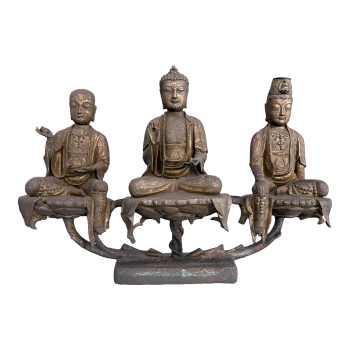
Bronze statue of the Joseon Dynasty "Three Amitabha"
This relic is a bronze statue named Amitabha Three, made in 1400 AD. This statue is from the South Korea of the Joseon Dynasty (AD 1392-1910). This statue is made of bronze material with traces of gilding. The overall dimensions of this statue are 40.6 x 16.5 x 54.6cm. Among them, Amitabha Buddha sits in the center of the lotus seat. On his left and right sides are two waiters: Ksitigarbha Bodhisattva and Guanyin Bodhisattva. The combination of these three was popular in the early Korean period. This statue is now in the collection of the Cleveland Museum of Art.

Korean Koryo period inlaid porcelain "chrysanthemum and peony inlaid hip flask"
This relic is inlaid porcelain decorated with chrysanthemum and peony patterns, made in the 1100 AD generation. Porcelain from the Koryo period (AD 918-1392) South Korea. This piece of porcelain is made of celadon and is decorated with white and black slip glaze. This piece of porcelain has an outer diameter of 15cm and a height of 18.8cm. The shape of this porcelain resembles a melon, inlaid with delicate chrysanthemum and peony patterns. In South Korea the flowers and leaves of chrysanthemum are used to make chrysanthemum wine. Chrysanthemum wine is enjoyed by people on the Double Ninth Festival (the ninth day of the ninth lunar month). This piece of porcelain is now in the collection of the Cleveland Museum of Art.

Popular Models

Random Model

Moka Pot (Moka Pot, espresso maker)
446 View
Movie Scene miniatures
1238 View

Tires
612 View
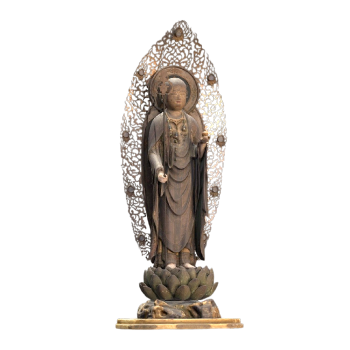
Ksitigarbha King Bodhisattva Statues
601 View
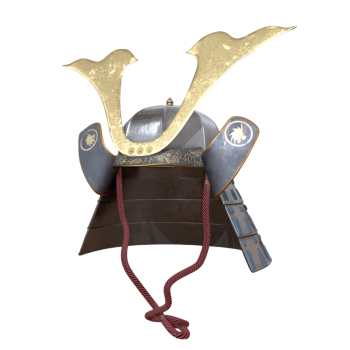
Japanese Samurai Helmet
569 View

Vintage Vintage Leather Single Sofa
374 View


Modern simple style gray fabric sofa
492 View
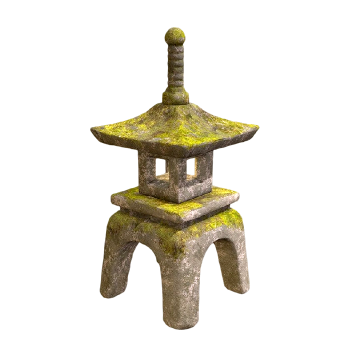
Japanese-style stone lanterns
594 View